

Couples Counseling for Complex Trauma: Can We Really Heal Together?
By Isaac Smith, MAT, LCSW, NTP
So it goes with the human condition—messy, chaotic, and beautiful in its imperfection. When you are living with complex trauma (C-PTSD), or loving someone who is, the "normal" advice for relationships often feels like trying to navigate a wild ride with a map that’s written in a language you don't speak. Reaching out when you’re feeling as vulnerable as a turtle without its shell isn’t just hard—it’s heroic.
In my years of sitting with people in their moments of deepest pain—from hospice beds to launching substance use programs at UC Davis Health—I’ve seen a recurring truth: we are "wired" for connection, but trauma rewires us for protection. If your relationship feels like a constant battle for safety, I want you to know: it’s not a character flaw; it’s a biological survival response.
Key Takeaways
Safety First: C-PTSD requires a "bottom-up" therapeutic approach that stabilizes the nervous system before traditional communication skills can work.
The Amygdala Hijack: During conflict, complex trauma takes the logical brain offline, making standard "I-statements" nearly impossible to use.
The Third Entity: Successful healing involves treating the relationship as its own living nervous system rather than blaming individual partners.
Co-Regulation: Partners can learn to act as "biological anchors" for one another, expanding their shared window of tolerance.
The Bottom Line
Trauma-informed couples therapy is a clinical framework that prioritizes nervous system safety and emotional stabilization over traditional conflict-resolution skills. Traditional counseling often fails for C-PTSD because complex trauma causes an "amygdala hijack," taking the logical brain offline during conflict. Healing requires "bottom-up" regulation to break "survival loops" and rebuild secure attachment through shared attunement.
What is Trauma-Informed Couples Therapy?
Trauma-informed couples therapy is a clinical framework that prioritizes nervous system safety and emotional stabilization over traditional conflict-resolution skills. This approach acknowledges that you cannot solve a problem while your body is in a state of high alert.
This isn't just "talk therapy." It is a framework that honors the fact that trauma lives in the body. We aren't just looking at what you say; we are looking at how your nervous systems are talking to each other when the room gets "loud."
This is often whytrauma-informed therapeutic approaches are the missing piece for survivors who feel "stuck" in standard marriage advice.
Why Standard Marriage Counseling Often Fails for C-PTSD
Most couples come to me after a "failed" stint in traditional therapy. They often feel like they are failing at therapy itself. But here is the thing: standard counseling assumes both partners have access to their logical, "thinking" brain (the prefrontal cortex) during a conflict.
Traditional counseling fails for C-PTSD because complex trauma causes an "amygdala hijack," where the brain's emotional center takes the logical prefrontal cortex offline during conflict. In this state, the body perceives a partner's tone or silence as a life-threatening danger rather than a simple disagreement.
Neurobiological data confirms that when the brain senses a threat, the emotional centers take over. Your body doesn't see a partner; it sees a danger. In these moments, "I-statements" are about as manageable as nailing jello to a tree.
The "Survival Loop": When Triggers Interlock
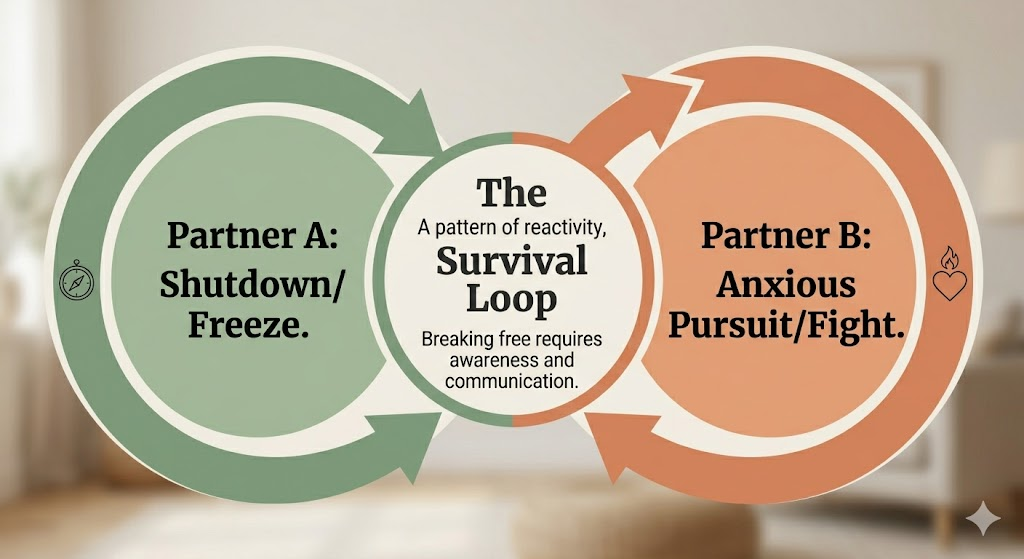
In my practice, I’ve watched countless couples get caught in what I call the Survival Loop. This isn't a lack of love; it’s a collision of nervous systems. It happens when Partner A’s trauma response directly triggers Partner B’s trauma response.
Partner A (The Shutdown): Feels overwhelmed -> Nervous system enters "Freeze" -> They withdraw or go silent to feel safe.
Partner B (The Pursuer): Sees the silence -> Nervous system interprets this as abandonment -> Enters "Fight" mode -> They "poke" to get a response.
The Result: A self-sustaining cycle where both people are fighting for their lives, but losing the "Us."
If this cycle feels familiar,you can find relief by exploring specialized couples counseling that understands these biological nuances.
The "Complex" in C-PTSD: Why Relational Trauma is Different
To understand why this loop is so powerful, we have to look at the "Complex" in the name. C-PTSD is born from prolonged, repeated exposure to trauma—often in contexts where we should have felt safe. As defined by theU.S. Department of Veterans Affairs, this differs from single-event trauma. In a relationship, this means your "safety radar" is permanently turned up to eleven.
You might experience:
Hyper-vigilance: Tracking your partner's micro-expressions for signs of anger.
Emotional Flashbacks: Feeling the same terror or shame you felt as a child, directed at your partner.
Intimacy Resistance: Interpreting closeness and vulnerability as a danger sign, leading to sudden withdrawal.
Treating the "Third Entity": A New Framework for Relational Healing
Most therapy treats "Person A" and "Person B." At Whole Wellness, we treat the "Third Entity"—the relationship itself as its own living, breathing nervous system.
Moving Beyond "I" and "You" to the Nervous System of "Us"
When we focus on the "Us," we stop looking for who is "wrong." We move toward attunement. Instead of asking, "Why are you acting like this?" we ask, "What does the 'Us' need right now to feel safe?" This shifts the perspective from "You are triggering me" to "The Survival Loop is happening again—how do we stop it together?"
I've found that when couples stop fighting each other and start fighting the Loop, the entire atmosphere of the home changes. You canlearn more about our team's approach to relational attunement here.
The Invisible Partner: Shame and Dissociation
In almost every trauma-informed session, two "invisible partners" are in the room: Shame and Dissociation. These elements often dictate the flow of the conversation without the couple even realizing it.
The Weight of Shame
For the survivor, shame is the "turtle shell." It’s the voice that says, "If you really knew me, you’d leave." When shame is triggered, vulnerability becomes impossible. We help couples recognize when shame is driving the bus so they can offer each other compassion.
The Fog of Dissociation
Dissociation is the body’s way of "leaving the room" when things get too intense. If your partner suddenly seems "blank," they aren't ignoring you—their system has reached its limit. Recognizing this "fog" is a critical step inhow complex trauma impacts long-term relationships.
The Biology of Co-Regulation: Using Your Partner as an Anchor
Co-regulation is the biological process where one person’s calm, grounded nervous system helps "anchor" another person’s chaotic one. This isn't just a psychological concept; it is a physiological reality.
In a relationship, you can learn to be each other's anchor. This is a core component ofPolyvagal Theory, which explains how our nervous systems scan for safety. When we sit together, we practice the literal biological art of staying "connected" while regulated.
Expanding Your "Couple’s Window of Tolerance"
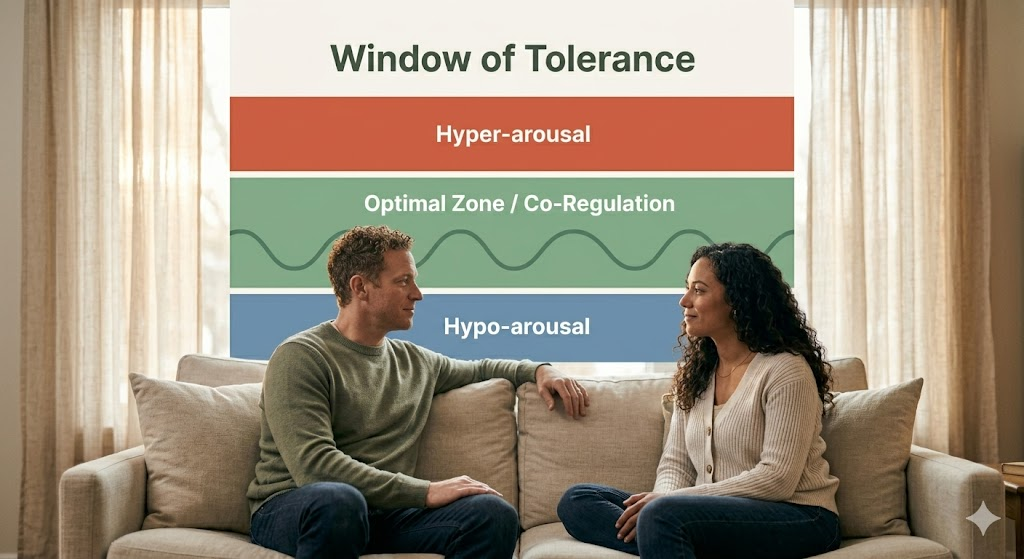
Your Window of Tolerance is the space where you can handle stress without crashing into a "fight" or "shutting down." We help you build a "Couple’s Window" by learning "Micro-attunements."
These are subtle cues like a shift in breath or a tightening of the jaw that signal your partner is leaving their window. Catching these early allows you to co-regulate before the "Survival Loop" takes over.
Relational Check-In:Feeling the "Relational Crash" right now? Take a breath. You canGet our free Grounding Guide for Couples navigating C-PTSD to help you and your partner find your footing when things feel bonkers.
Evidence-Based Paths: EFT, PACT, and Somatic Tools
We use vetted, evidence-based modalities designed specifically for the unique "wild ride" of complex trauma. No single approach works for everyone, so we tailor the tools to your specific "Third Entity."
Comparing Modalities: Which One is Right for Us?
Approach
Core Focus
Why it Works for C-PTSD
EFT (Emotionally Focused)
Attachment cycles.
Validated by the APA, it replaces "Survival Loops" with secure bonding.
PACT (Psychobiological)
Nervous system regulation.
Uses biological "bottom-up" techniques to help partners calm each other's bodies.
Somatic/Body-Based
Body-stored trauma.
Ideal forhealing attachment wounds where the body remembers what the mind forgets.
Brainspotting
Subcortical processing.
Helps both partners process shared relational triggers at a deep brain level.
7 Steps to De-Escalate a Trauma Response in Real-Time
To de-escalate a trauma response, partners must halt the narrative immediately and focus on biological grounding. When you're triggered, your "thinking brain" won't remember complex strategies, so we keep it simple.
Acknowledge the Crash: Name it out loud: "I think the Survival Loop is happening."
The "Safety Stop": All discussion of the "topic" (money, kids, chores) stops immediately.
Physical Grounding: Sit back-to-back or hold hands if safe. Focus on the literal weight of your bodies.
The Sensory Shift: Drink cold water, step outside, or name 5 things you can see right now.
The "Check-In": Ask, "What does your body need right now?" (e.g., "I need a heavy blanket").
The Validation Anchor: Say: "I can see that your system felt unsafe, and I'm here now."
The Scheduled Repair: Do not resolve the argument until both of you are "back in your window."
Finding the Right Specialist: What to Ask
Not all therapists are trauma-informed; finding a specialist means asking if they treat the relationship as its own 'nervous system'. When looking for a "fellow traveler" to help youwork through relational triggers, ask these questions:
"How do you handle dissociation or high arousal in the session?"
"What is your specific training in C-PTSD and attachment?"
"Do you believe in treating the relationship as its own 'nervous system'?"
FAQs: Common Concerns About C-PTSD and Intimacy
Can C-PTSD ruin a relationship?
It adds layers of complexity, but it doesn't "ruin" them. In many cases, healing together creates a depth of intimacy that other couples never reach.
What if I feel "burned out" by my partner's trauma?
Compassion fatigue is real. A trauma-informed therapist will support you, too, helping you set healthy boundaries while remaining an "anchor."
Should we do individual or couples therapy first?
It’s a "both/and" situation. Individual therapy heals your "turtle shell," while couples therapy builds a safe "home" for both turtles.
The Path Forward: Resilience in the Messy Middle
Healing isn't a straight line; it’s a spiral where you learn to recognize the 'Survival Loop' earlier each time. Having supported hundreds of individuals and families throughout Northern California, I've seen that progress isn't about the absence of conflict, but the presence of repair.
You’ll recognize the "wind getting knocked out of your sails" earlier, and you’ll know how to reach for each other’s hand. You don’t have to drive the bus alone. Our team providingmental health support in Sacramento, Fair Oaks, and San Diego is here to guide you.
Ready to find your grounding?Break the Survival Loop with a Free 20-Minute Consultation. Let's help you and your partner find relief together.
About the Author
Isaac Smith, MAT, LCSW, NTP, is a Licensed Clinical Social Worker, functional nutritional therapy practitioner, and the founder of Whole Wellness Therapy. With a deep clinical background spanning UC Davis Health and community mental health, Isaac is currently pursuing his Doctorate in Clinical Psychology. He is dedicated to a neuro-affirming, "people-first" mission, helping individuals and couples navigate the "messy middle" of trauma recovery with grounded, somatic, and evidence-based care.Learn more about Isaac and the WWT team here.
Medical Disclaimer
This content is provided for informational and educational purposes only and is not intended as medical advice or a substitute for professional clinical diagnosis, treatment, or consultation. Always seek the advice of your physician or a qualified mental health provider with any questions you may have regarding a medical or psychological condition.
Crisis Support
If you or your partner are in immediate danger or experiencing a mental health crisis, please utilize the following resources:
Emergency: Call 911
Suicide & Crisis Lifeline: Call or Text 988
Crisis Text Line: Text HOME to 741741