

How to Talk to Your Partner About Therapy: A Scripts Guide
By Isaac Smith, MAT, LCSW, NTP
Licensed Clinical Social Worker | Founder, Whole Wellness Therapy | Sacramento & Fair Oaks, CA
Reading time: 10–12 minutes
Key Takeaways
Most couples wait too long. Research from the Gottman Institute shows the average couple waits six years before seeking help — by which point small, fixable problems have often become deeply entrenched ones.
How you bring it up matters as much as what you say. Timing, framing, and tone make the difference between a conversation that opens a door and one that slams it shut.
Therapy isn't a verdict on your relationship. Framing it as a last resort is one of the most common mistakes couples make — and one of the most preventable.
Scripts help. Having actual words ready reduces anxiety, lowers defensiveness, and keeps the conversation on track when emotions run high.
Your partner's resistance is usually about fear, not refusal. Stigma, past experience, and vulnerability concerns drive most pushback. Understanding the real objection changes how you respond to it.
You can start alone. If your partner isn't ready, individual therapy is still enormously valuable — and often shifts the relational dynamic over time.
Asking for help isn't weakness. In fifteen years of clinical work, the clients I've seen grow the most are the ones who were brave enough to reach out before things fell apart.
Bringing up therapy with a partner is one of those conversations that lives in the back of your mind for weeks before it ever happens. You rehearse it in the shower. You time it for a Sunday morning when things are calm. You wonder if they'll take it as criticism, as a warning sign, as evidence that you've already checked out.
I hear this all the time — in first sessions, in consultations, in the messages people send before they're quite ready to make an appointment. The conversation itself has become a barrier to the help people need.
So let's break that barrier down. This is a practical guide with real scripts, real scenarios, and the clinical reasoning behind each approach. Use what fits your relationship and leave what doesn't. There's no single right way to have this conversation — but there are definitely better and worse ones.
Why This Conversation Is So Hard
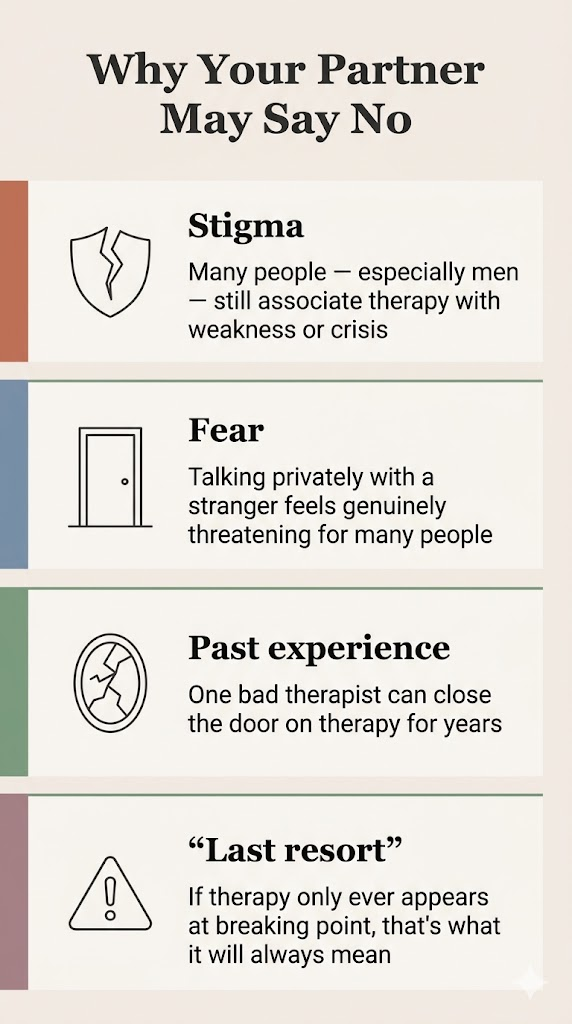
Before we get to the scripts, it's worth understanding what's actually happening psychologically when someone resists the idea of therapy. If you walk into this conversation treating it like a logic problem — here are the facts, please agree — you will almost certainly hit a wall.
Resistance to therapy is rarely about therapy. It's usually about one of these four things:
Stigma. Despite meaningful cultural shifts, many people — particularly men — still associate therapy with weakness or crisis.The American Psychological Association has documented that men are substantially less likely to seek mental health treatment, largely due to societal expectations around self-reliance and stoicism.
Fear of exposure. Sitting with a stranger and talking about the most private parts of your relationship is genuinely vulnerable. For someone who wasn't raised in an environment where vulnerability was safe, the prospect is threatening — not irrational.
Past bad experiences. A previous therapist who felt judgmental, unhelpful, or like they took sides can poison the well for years. This is a real concern that deserves to be addressed directly, not dismissed.
The "last resort" association.Research from the Gottman Institute shows the average couple waits six years before seeking help with relationship problems. By that point, therapy has only been sought in full-blown crisis — so the association between therapy and "the relationship is ending" is understandable, even if it's inaccurate.
Your job in this conversation is not to win an argument. It's to lower the threat level enough that your partner can actually hear you.
Before You Have the Conversation
A few things to get right before the words leave your mouth.
Choose the right moment
This conversation deserves a calm window — not the tail end of an argument, not right before bed, not in the car. A relaxed weekend morning or an easy evening when you're both settled and not mid-conflict is genuinely better. It sounds obvious, but most people bring this up in the worst possible moment because they've been building up courage and finally can't hold it in.
Start with yourself, not your partner
The single most effective thing you can do is lead with your own experience rather than your partner's behavior. "I have been feeling disconnected and I don't know how to talk to you about it" is a fundamentally different opening than "We keep having the same fights and nothing changes." Both might be true. Only one invites your partner in.
Know what you're asking for
Are you suggesting individual therapy — for yourself, for them, or both? Couples therapy together? These are different conversations with different implications. Going in without clarity creates confusion and makes it easier for a resistant partner to deflect.
The Scripts: Six Scenarios
Scenario 1: You want to suggest couples therapy and you're not sure how they'll react
This is the most common situation — you sense things could be better, you're not in crisis, but you want support before you get there.
Script:
"I've been thinking about something and I want to talk to you about it — not because I think we're in trouble, but because I care about us enough to want to invest in us. I've been reading about couples therapy and I think it could be genuinely good for us — not to fix something that's broken, but to give us tools we don't have yet. Would you be open to exploring it together?"
Why this works: It leads with investment and care, not alarm. It reframes therapy as proactive rather than reactive. The ask is low-pressure — "would you be open to exploring" rather than "will you go."
If they say:"I don't think we need that."Try:"I hear you. I'm not saying we're falling apart. I'm saying I want us to be really good, not just okay — and I think having a third perspective could help with some of the patterns I've noticed. Can we just talk about it a little more?"
Scenario 2: You've been in individual therapy and want your partner to try it too
You've done some of your own work and can see how much it's helped. You want the same for them — but bringing it up without making them feel compared or pressured takes care.
Script:
"Therapy has honestly changed a lot for me — the way I understand myself, the way I handle things. I'm not saying you need to do what I did. But I see you carrying a lot, and I wonder sometimes if having someone in your corner might help. Not because anything's wrong with you — just because you deserve that kind of support too."
Why this works: It shares your experience without prescribing theirs. It frames therapy as something they deserve, not something they need to fix a problem. And it validates that they're carrying something — which acknowledges rather than pathologizes.
If they say:"Therapy is not really my thing."Try:"What makes you say that? I'm curious — did you have a bad experience before, or is it more that it feels uncomfortable to think about?" Then listen. The specific objection tells you what actually needs addressing.
Scenario 3: You're navigating something specific — grief, a major life transition, or a trauma
When there's a concrete event or stressor in the picture, the conversation becomes more grounded. You're not asking them to examine themselves in the abstract — you're asking for support with something specific.
Script:
"I think what happened with [the loss / the job / the move / what we went through] has affected us more than we've acknowledged. I don't want us to just push through it and hope it gets better. I'd really like us to talk to someone — not because I blame either of us for how we've been, but because this was hard and we deserve some help processing it together."
Why this works: It names something real and external rather than placing the problem inside the relationship or either person. It normalizes needing support after difficulty — something most people can agree on even if they're resistant to therapy in the abstract.
If grief or loss is part of what you're navigating, our post onhow culture shapes our grieving process may be worth reading together before the conversation.
Scenario 4: Your partner struggles with anxiety, depression, or emotional regulation — and it's affecting your relationship
This is one of the most delicate conversations to have, because the line between "I'm concerned about you" and "you are the problem" is razor thin — and your partner will immediately feel which side of it you're on.
Script:
"I love you, and I've been worried about you. I've noticed you seem really weighed down lately, and I don't say that as a criticism — I say it because I hate seeing you struggle and I want you to feel better. I've been thinking about whether talking to someone might help — not because there's something wrong with you, but because you're dealing with a lot and you don't have to do it alone."
Why this works: It centers concern for them, not frustration with how their struggles affect you. Even if both are true, the order matters. Come with love first. The practical conversation about how their mental health affects the relationship can come later, once they're in the room and safe.
If they say:"I can handle it myself."Try:"I know you can. You've always been strong that way. But strength isn't the same as not needing support — and you'd never tell me I had to handle everything alone. Can we just keep the conversation open?"
Ifpeople-pleasing oremotional dysregulation are part of what you're observing, those posts may help you find words your partner can actually hear.
Scenario 5: There's been a betrayal or breach of trust
This is the highest-stakes version of the conversation. Whether it's infidelity, a significant lie, or a pattern of harm, the power dynamics are different — and the conversation requires more precision.
Script (for the person who was hurt):
"I want to try to work through this. I don't know yet what that looks like, and I'm not ready to make any decisions about us — but I know I can't do it without support. I'd like us to see a therapist together. Not to fix us overnight, but to have a safe place to have the conversations I don't know how to have right now."
Script (for the person who caused the harm):
"I know I hurt you, and I'm not going to minimize that. I want to make this right — and I think part of that means getting help. I'd like us to see someone together, not to make excuses for what I did, but because I want to understand it and I want to show you I'm taking this seriously."
Why both work: They name the reality without catastrophizing or minimizing. They frame therapy as a process, not a solution — which is both more honest and more reassuring than promising it will fix everything.
Betrayal trauma has a specific clinical shape that most people don't recognize in themselves. That post explains what's happening and why it takes more than good intentions to heal.
Scenario 6: Your partner has refused before — and you're trying again
You've had this conversation. They said no. Time has passed, something has shifted, and you want to try again without triggering the same shutdown.
Script:
"I know we've talked about this before and it wasn't the right time for you. I'm not bringing it up to pressure you — I just want you to know it's still something I'd really like for us. Things feel different to me lately, and I think I'd feel a lot better if we had some support. Would you be willing to at least revisit the idea? We don't have to decide anything tonight."
Why this works: It acknowledges their previous position without making them defend it again. "We don't have to decide anything tonight" removes the pressure that likely killed the conversation last time. It names your own feeling without placing responsibility on them.
What to Do When They Still Say No
Not every conversation ends with a yes. Sometimes you do everything right and your partner still isn't ready. Here's how to navigate that without losing yourself in the process.
Don't issue ultimatums in the moment. Ultimatums issued in the heat of a hard conversation almost never land well. If you genuinely feel the relationship cannot continue without therapeutic support, that's a serious and valid boundary — but it deserves its own conversation, separate from the initial ask.
Go to therapy yourself. This is not a consolation prize.Individual therapy — working on your own patterns, communication, and history — is enormously valuable regardless of whether your partner joins you. It also frequently shifts the relational dynamic in ways that bring a resistant partner closer to being ready. I've seen it happen more times than I can count.
Keep the door open without holding it open indefinitely. You can return to the conversation in a few weeks without it feeling like nagging. A simple "I just want you to know it's still something I care about" keeps the topic alive without pressure.
Be honest with yourself about what you need. If your partner's refusal to engage with their own mental health is becoming a genuine threat to the relationship's viability, that's important information — and a therapist can help you think through what it means for you.
Couples Therapy vs. Individual Therapy: Know Which One You're Asking For
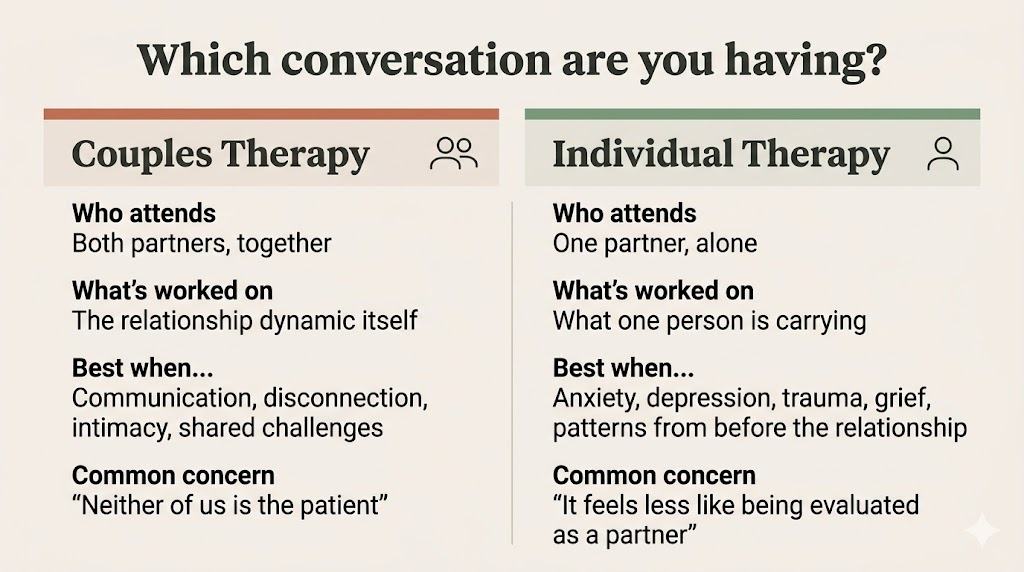
One source of confusion in this conversation is the difference between suggesting couples therapy and suggesting individual therapy. They're meaningfully different asks that require different conversations.
Couples therapy means both of you are in the room, working on the relationship together. Neither person is "the patient" — the relationship itself is what's being worked on. This is the right frame when the primary concern is communication, connection, intimacy, or navigating something as a unit. Ourcouples counseling andrelationship therapy services are built around exactly this.
Individual therapy for your partner means they have their own space to work on what they're carrying. This is often the right starting point when they're dealing with anxiety, depression,trauma, grief, or patterns that predate the relationship. Many people find it less threatening than couples therapy because it feels less like being evaluated as a partner.
You can want both, and it's fine to say so. But knowing which one you're primarily asking for — and why — makes the conversation cleaner.
If trauma is part of the picture, our posts ontrauma and the brain andabandonment trauma and attachment styles offer language that can help both of you understand what's happening beneath the surface.
Common Questions
What if bringing up therapy starts a fight?
It might. That doesn't mean you did it wrong — it sometimes means the conversation touched something real. If it escalates, say: "I don't want this to become an argument. I brought this up because I care about us, not because I want to fight. Can we come back to it when things are calmer?" Then actually come back to it.
Should I find a therapist before I have the conversation?
It can help. Having a specific name, website, or practice makes the ask feel concrete rather than abstract, and signals you've thought about this seriously. That said, doing the research together can also help a hesitant partner feel like they have agency in the process rather than being handed a decision already made.
What if my partner agrees but then keeps cancelling or stalling?
That's a form of ambivalence worth naming — gently and directly. "I've noticed we keep pushing this back and I'm starting to feel like it's not going to happen. Can we talk about what's getting in the way?" The stalling is information, and it deserves its own conversation.
Is it manipulative to use scripts?
No. Scripts are prepared language — the same thing you do before any high-stakes conversation with a boss, a family member, or a doctor. Having words ready doesn't make a conversation inauthentic. It makes it more likely to go the way you intend.
Ready to Take the First Step?
Whether you're coming as a couple or starting on your own, the hardest part is usually just making the call. You don't need to have everything figured out before you reach out — that's what the first session is for.
Our therapists inSacramento,Fair Oaks, andonline across California work with individuals and couples at every stage — including the stage where one person is on board and the other isn't sure yet. We're used to meeting people where they are.
Schedule your free 20-minute consultation →
No obligation. No pressure. Just a conversation to see if we're the right fit.
Also worth exploring: →Couples Counseling at Whole Wellness →Individual Therapy in Sacramento & Fair Oaks →Relationship Therapy
If you or someone you know is in immediate crisis, please visit ourcrisis resources page or call the 988 Suicide & Crisis Lifeline by dialing or texting 988.
About the Author
Isaac Smith, MAT, LCSW, NTPLicensed Clinical Social Worker | Founder & Executive Director, Whole Wellness Therapy
Isaac Smith is a licensed clinical social worker, functional nutritional therapy practitioner, and the founder of Whole Wellness Therapy. With over fifteen years of experience working with individuals, couples, and families — from DBT agencies to hospice organizations to UC Davis Health — he brings a grounded, whole-person perspective to the full range of human struggles.
He specializes in trauma, addiction, anxiety, and relational healing, and has spent much of his career helping people find the courage to ask for support before things fall apart.
Isaac sees clients in Fair Oaks and online throughout California. California BBS License: LCSW75372
References & Further Reading
Gottman Institute research on couples seeking help. Via The Minds Journal.https://themindsjournal.com/its-time-to-stop-the-stigma-around-couples-therapy/
American Psychological Association. Men and mental health: Barriers to treatment.https://www.apa.org/topics/men-boys/mental-health
Gottman, J. M. & Gottman, J. S. The Gottman Method. The Gottman Institute.https://www.gottman.com/about/the-gottman-method/
Capozzi, F. (2025). A research-driven flowchart to approach change in couples. Frontiers in Psychology.https://pmc.ncbi.nlm.nih.gov/articles/PMC11743556/
Nazari, A. M. et al. (2018). Effectiveness of Gottman couple therapy on marital adjustment and intimacy. Iranian Journal of Psychiatry and Behavioral Sciences.https://pmc.ncbi.nlm.nih.gov/articles/PMC6037577/