

How Does Trauma Affect the Brain? The Science of Staying Alive
By Isaac Smith, MAT, LCSW, FNTP
When you go through trauma, it often feels like someone reached into the cockpit of your life and swapped out the flight manual. One day you’re moving through the world with a bit of ease; the next, you feel as vulnerable as a turtle without its shell.
In my practice here in California, I sit with people every day who feel "tethered" to a past they can’t escape. They tell me they feel broken. But the truth is actually much more interesting: your brain is doing exactly what it was built to do. It’s trying to keep you alive.
Key Takeaways
The Survival Trinity: Trauma forces the amygdala to over-react while the parts of the brain that handle logic and memory struggle to stay online.
Beyond Fight or Flight: A "brain shutdown" is usually a biological Freeze response. "Fawning" is a people-pleasing strategy used to stay safe.
The Window of Tolerance: Learning to identify when you are "hyper-aroused" (anxious) or "hypo-aroused" (numb) is the first step to regulation.
Your Heritage: Stress baselines can be inherited. Some of us are born with a nervous system that is naturally more "primed" for high-alert living.
The Body Connection: Real healing means looking at neuro-inflammation and gut health alongside therapies like EMDR and Brainspotting.
Rewiring is Possible: Because of neuroplasticity, the brain can physically change for the better within 8 to 12 weeks of the right kind of care.
The Survival Trinity: Why Your Brain Stays on High Alert
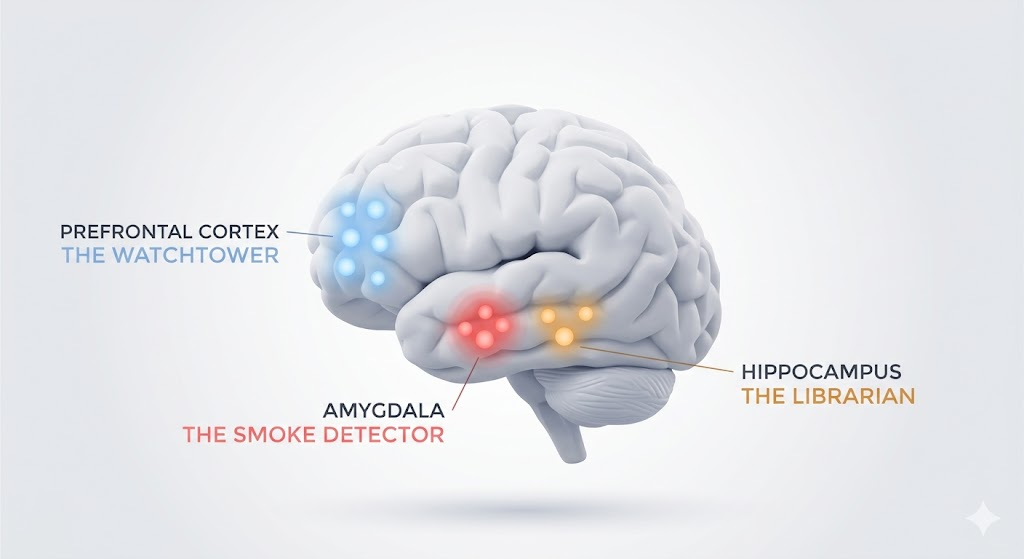
If you want to understand why you feel so "unmoored," you have to look at the three parts of the brain that manage your stress. Think of them as a team that stopped talking to each other because the "fire alarm" got stuck in the 'on' position.
1. The Amygdala: The 24/7 Smoke Detector
This is your instinctual center, a tiny almond-shaped structure deep in the temporal lobe. Its only job is to scan your surroundings for threats. When trauma happens, the amygdala doesn't just record a memory; it burns in a survival blueprint.
In a healthy brain, the amygdala signals a threat, and once the danger passes, it stands down. In a traumatized brain, it becomes so sensitive that it can't tell the difference between a shadow on the wall and a real intruder. It lives in a state of permanent "high alert." This is why a specific smell, a certain tone of voice, or even a particular time of day can trigger a full-body panic response.
2. The Prefrontal Cortex: The Watchtower
This is the "rational" part of your brain, located right behind your forehead. It is responsible for complex decision-making, social behavior, and—most importantly—emotional regulation. Usually, the Watchtower looks down at the Smoke Detector and says, "That's just a car backfiring, not a gunshot. We're okay."
During trauma, however, the neural pathways to the Watchtower "go dark." This is called "top-down" dysregulation. You get stuck in a purely reactive state, unable to talk yourself down because the parts of the brain that handle language and logic are effectively offline. You aren't "being dramatic"; your brain has physically lost its ability to regulate.
3. The Hippocampus: The Librarian
The hippocampus is supposed to "time-stamp" your memories and file them away. It tells your brain, "That happened in 2012, and this is happening now."Research from the NIH suggests that chronic trauma can actually shrink the hippocampus by as much as 8% to 12%.
When that happens, the Librarian can't file the trauma away as something that happened. Instead, your brain perceives the memory as something that is happening right now. This is the biological root of flashbacks. To your brain, the past isn't a memory—it’s a current event.
The Window of Tolerance: Mapping Your Nervous System
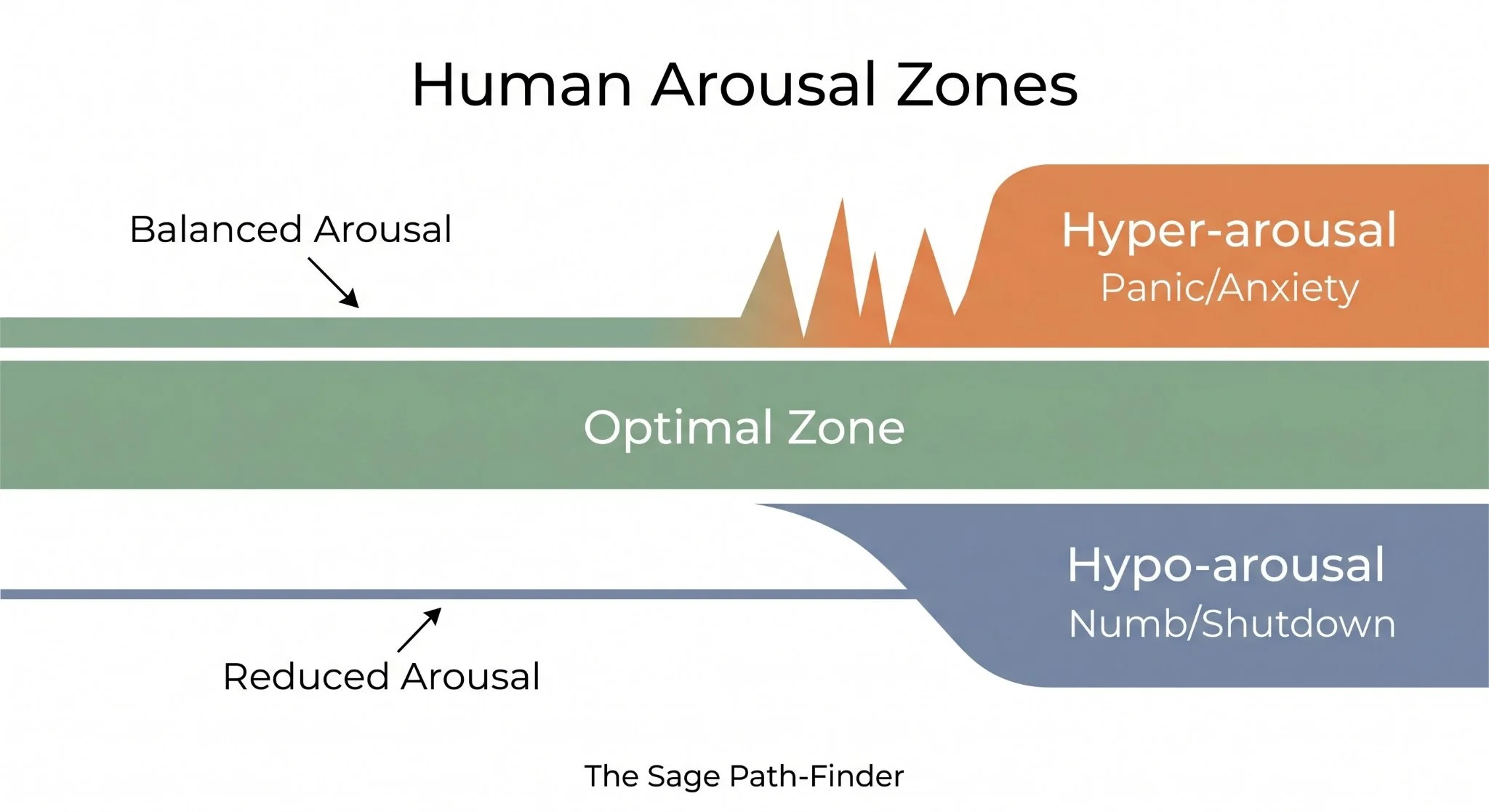
In therapy, we often talk about the "Window of Tolerance"—the zone where you can handle the ups and downs of life without crashing. When you’ve experienced trauma, that window often shrinks, making it much easier to be "pushed out" into survival mode.
Hyper-Arousal (The "On" Switch)
When you are pushed out of the top of your window, you enter hyper-arousal. This is the realm of the amygdala. You might experience:
Racing thoughts and a pounding heart.
A constant "need" to be doing something or "fixing" something.
Extreme irritability or anger over small inconveniences.
An inability to sleep because your brain won't stop scanning for "what's next."
Hypo-Arousal (The "Off" Switch)
When you are pushed out of the bottom of your window, you enter hypo-arousal. This is the "brain shutdown" many people describe. You might experience:
Emotional numbness or feeling "flat."
A sense of being disconnected from your body (dissociation).
Low energy and a "heavy" feeling in your limbs.
Difficulty thinking clearly or finding words.
| Feature | The Regulated Brain | The Traumatized Brain |
|---|---|---|
| Response | Calm and reflective | Reactive and high-alert |
| Perspective | Sees the big picture | Focuses on the immediate threat |
| Memory | Linear (the past stays in the past) | Fragmented (the past feels like today) |
| Primary Driver | Prefrontal Cortex ("Watchtower") | Amygdala ("Smoke Detector") |
Beyond Fight or Flight: When the Brain "Crashes"
The human survival toolkit is much bigger than just "fight or flight." Many of my clients here in Sacramento describe a feeling of "brain shutdown" or a "crash." This usually happens when the brain decides that fighting or running is impossible.
The Freeze Response: The Emergency Brake
When your nervous system is hit with a threat it can't escape—like physical violence, an overwhelming loss, or a deep betrayal—it pulls the emergency brake. This is the Freeze Response.
You might feel numb, cold, or disconnected. Biologically, this is your body’s way of "playing dead" to dull the pain or avoid being noticed by a predator. For many high-functioning professionals, this "crash" often looks like sudden, unexplained burnout or an inability to complete simple tasks that used to be easy.
The Fawn Response: Survival Through People-Pleasing
There is a fourth response we don't talk about enough: Fawning.
Fawning is a survival strategy where the brain tries to "people-pleasing" or diffuse a conflict just to stay safe. It’s a sophisticated tool often built in childhood to handle an unpredictable or threatening environment at home.
If you grew up needing to monitor a parent's mood to stay safe, your brain learned that your boundaries were a threat to your survival. Fawning isn't a "weakness" in your personality; it’s a brilliant way your brain learned to stay alive by prioritizing the needs of others over your own.
(If you find yourself constantly fawning or "crashing out," ourtrauma therapy in Sacramento can help you learn to set boundaries from a place of safety.)
The Epigenetic Link: Can You Inherit Trauma?
Your baseline for stress might have been set before you ever took your first breath. We used to think our genes were static, but the field of Epigenetics has changed everything.Studies in Biological Psychiatry show that the stress experienced by parents—and even grandparents—can leave "chemical signatures" on the DNA of their children.
This means that if your ancestors lived through prolonged periods of instability or danger, your amygdala might have been born "pre-tuned" to a higher frequency of fear. You might find yourself feeling anxious in a safe environment because your nervous system is carrying the "survival echoes" of the generations before you.
Knowing this doesn't make you a victim of your genes. Instead, it offers a map. It explains why you might have to work a little harder at regulation than someone else—not because you're broken, but because your starting line was different.
Nutritional Neurobiology: Feeding Your Recovery
As a Functional Nutritional Therapy Practitioner (FNTP), I look at trauma through a lens most therapists miss. Trauma isn't just "in your head." It’s a physical event that uses up every resource your body has. When the brain is in survival mode, it sends signals to the rest of the body to deprioritize "non-essential" functions like digestion and immune response.
Over time, this leads to neuro-inflammation, which makes the "soil" of your brain less fertile for change. If your brain is inflamed, neuroplasticity is much harder to achieve.
The Micronutrient Drain
Chronic stress is expensive for the body. It burns through specific nutrients at an alarming rate:
B-Vitamins: These are the "spark plugs" for your neurotransmitters. Without them, your brain can't make the chemicals needed to keep your Watchtower (prefrontal cortex) online.
Magnesium: This is the "calming mineral." Trauma "wastes" magnesium, leading to tight muscles, poor sleep, and a brain that feels like it’s constantly vibrating.
Zinc and Vitamin C: Essential for your adrenal health. When these are low, you lose your "buffer" against daily stress.
The Gut-Brain Axis
Approximately 95% of your serotonin—the chemical that helps you feel calm and safe—is made in your gut.Harvard Health has shown that a "leaky" or inflamed gut sends signals of distress directly back to the amygdala. If your gut is in trouble, your brain will struggle to believe it is safe.
A 3-Step Protocol for a Calmer Brain:
Eat more Omega-3s: Found in fatty fish or high-quality supplements, these act as insulation for your brain cells, reducing the "static" of neuro-inflammation.
Keep Blood Sugar Stable: When your blood sugar drops, your body pumps out adrenaline to bring it back up. This adrenaline mimics the feeling of a panic attack, which can "re-trigger" a traumatized amygdala.
Prioritize Amino Acids: These are the building blocks of GABA—the brain's primary "brakes." Without enough protein, your brain can't stop the runaway train of anxious thoughts.
Neuroplasticity: Why There is Real Reason to Hope
Trauma feels permanent because it changes the physical structure of the brain, but here is the good news: the brain is "plastic."Neuroplasticity is the brain’s ability to grow new connections and "prune" away old, unhelpful ones.
In therapy, we aren't just talking about your past. We are doing work that physically strengthens your prefrontal cortex and helps the "Librarian" (hippocampus) file away the past.
Top-Down vs. Bottom-Up Healing
Top-Down (The Logical Approach): Things like CBT (Cognitive Behavioral Therapy) use your Watchtower to talk your Smoke Detector down. This is great for daily stress, but it often fails during a trauma trigger because the Watchtower is effectively offline.
Bottom-Up (The Somatic Approach): This is where we see the most profound changes. Tools like Brainspotting, EMDR, and Somatic Experiencing work directly with your nervous system. They bypass the logical brain and talk directly to the amygdala, helping it realize that the threat is over.
Peer-reviewed research shows these methods can lead to real structural changes in the brain in as little as 8 to 12 weeks. We offerspecialized trauma therapy in California that taps into this biological ability to change.
Trauma and the High-Achiever: The "High-Functioning" Trap
For many of my clients in San Diego and Sacramento, trauma doesn't look like a "crash"—it looks like a promotion. There is a specific type of trauma response called High-Functioning Anxiety.
In this state, your amygdala is driving your ambition. You use "fear of failure" or "hyper-vigilance" to fuel your career. You’re the most productive person in the office, but you’re also the most exhausted. Your brain is stuck in a "Flight" response, but instead of running away from a predator, you're running toward the next deadline.
This is unsustainable. Eventually, the brain will hit its limit and force a "shutdown" (burnout). Recognizing that your "drive" is actually a trauma response is the first step to finding a way to work and live from a place of peace rather than panic.
Trauma-Informed Yoga: Resetting the Body
One of the fastest ways to tell your brain "we are safe" is through the body.Trauma-Informed Yoga classes aren't about getting a "workout"; they are about interoception—the ability to actually feel what is happening inside your own skin without being overwhelmed.
A 2-Minute Grounding Exercise for Right Now:
The 5-4-3-2-1 Technique: Name 5 things you see, 4 you can touch, 3 you hear, 2 you smell, and 1 you can taste. This forces your brain to shift out of "Survival Mode" (Amygdala) and back into "Observational Mode" (Prefrontal Cortex) by focusing on sensory data in the present moment.
The Vagus Nerve Reset: According to thePolyvagal Institute, splashing cold water on your face or gently pulling on your earlobes stimulates the Vagus Nerve. This sends an immediate signal to your heart and brain that the danger has passed.
Common Questions About Recovery
Can my brain ever go back to "normal"?
The brain doesn't usually go back; it grows forward. You build more resilient pathways that help you navigate life with more peace. You aren't "repaired"—you are becoming more integrated. Think of it as a "software update" for your nervous system.
How long does it take to see a change?
There is no set schedule, but we do know that consistent work can lead to physical changes in brain structure within a few months. Most people start feeling more "breathable" space in their daily lives within 4 to 6 sessions of somatic work.
Moving Toward Wholeness
You aren't broken. You are adaptable. Your brain has spent years perfecting the art of survival. It has kept you alive through things that were meant to break you. Now, we can help it learn the art of actually living—not just surviving.
If you’re feeling unmoored, let’s talk. Whether you’re in Sacramento, Fair Oaks, or San Diego, we are here to walk this path with you as fellow travelers.
The First Step: Reaching out is the hardest part.Schedule your free 20-minute consultation today to see how we can help you find your baseline again.
About the Author
Isaac Smith, MAT, LCSW, FNTP is the founder of Whole Wellness Therapy. With over a decade of experience, Isaac uses a neuro-affirming, integrative approach to bridge the gap between psychotherapy and nutrition. He helps people move from survival to wholeness by treating the mind and body as one system.Learn more about Isaac here.
Medical Disclaimer: This content is for educational purposes and is not a substitute for professional medical advice, diagnosis, or treatment. Always talk to your doctor about any medical or mental health concerns.
Crisis Support: If you are in a mental health emergency, please reach out. Call or text 988 for the Suicide & Crisis Lifeline, call 911, or text HOME to 741741 to connect with the Crisis Text Line.