Somatic Therapy and EMDR: Why Your Body Holds the Key to Abuse Recovery
By: Isaac Smith, MAT, LCSW, NTP (NPI: 1275979072)
For many survivors of abuse, traditional "talk therapy" eventually hits a plateau. You may have spent years articulating what happened to you, deconstructing the abuser's tactics, and understanding your triggers intellectually. Yet, despite this high level of insight, your body remains stuck in the past. When triggered, your heart still races, your throat tightens, and that familiar wave of panic or numbness—the "somatic freeze"—takes over as if the trauma were happening in the present moment. While many understand the neurobiology of trauma bonds, resolving the physical 'anchor' requires a bottom-up approach.
This disconnection between the mind and the body is one of the most frustrating aspects of trauma recovery. At Whole Wellness Therapy, we believe this happens because trauma is not just a "thought" problem; it is a physiological one. To truly heal, we must move beyond the "top-down" approach of talking and embrace a "bottom-up" revolution that targets the nervous system directly.
This guide explores the two gold-standard modalities for body-based healing: EMDR (Eye Movement Desensitization and Reprocessing) and Somatic Experiencing.
What is the difference between EMDR and Somatic therapy?
While both are evidence-based trauma treatments, the primary difference is their entry point: EMDR focuses on desensitizing traumatic memories through bilateral stimulation (like eye movements), while Somatic Therapy focuses on resolving the physical tension and "freeze" responses stored in the body. For survivors of abuse, an integrative approach using both is often the most effective way to achieve long-term nervous system regulation.
Key Takeaways: Healing Beyond the Narrative
The Bottom-Up Approach: Healing starts with the nervous system (body) rather than the logical mind (talk).
EMDR's Role: Specifically designed to process "stuck" memories that cause emotional flashbacks.
Somatic Experiencing's Role: Focuses on the Vagus Nerve to release the physical energy of the "freeze" response.
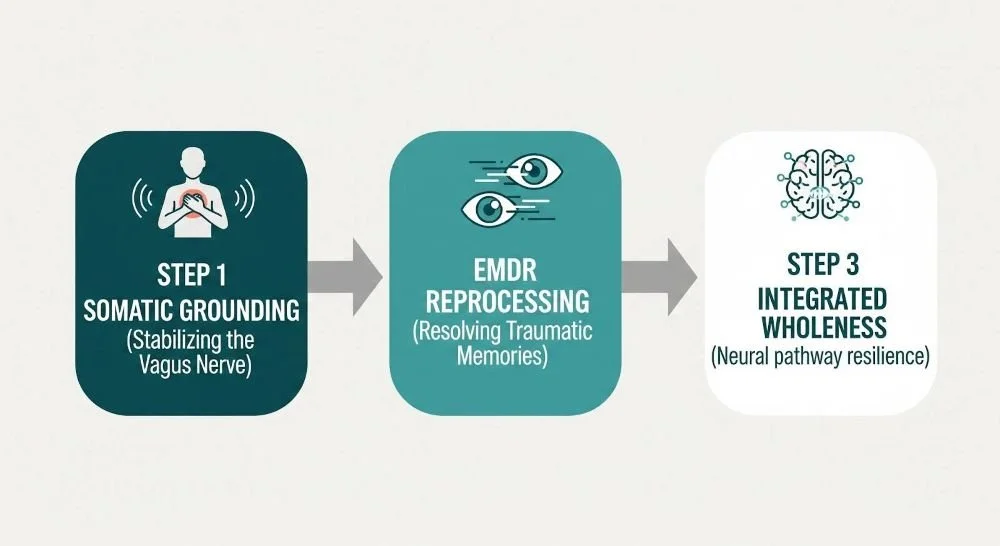
Integrative Recovery: Using Somatic grounding to stabilize the body before using EMDR to reprocess the trauma is a proprietary focus at WWT.
Why Talk Therapy Isn't Always Enough for Trauma
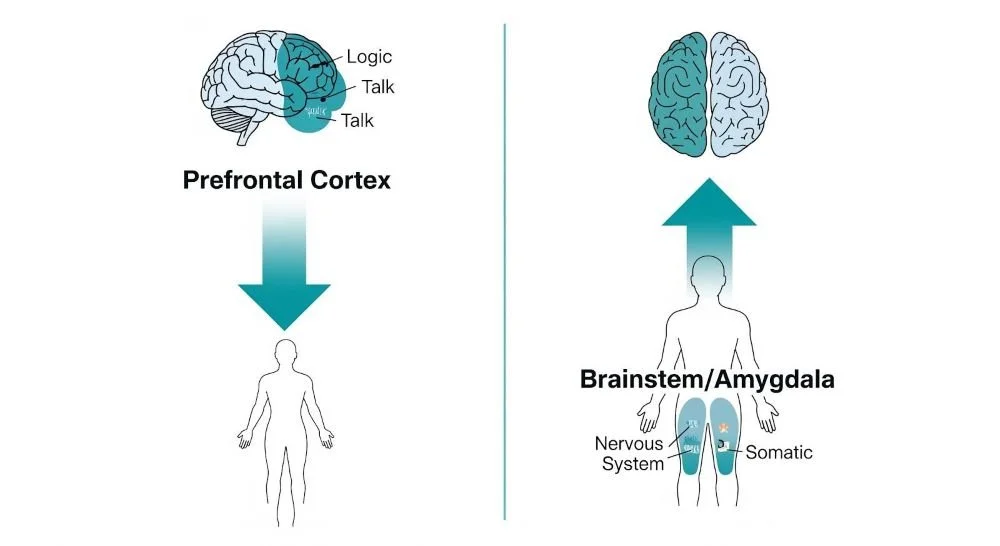
Traditional psychotherapy is a "top-down" approach. It relies on the prefrontal cortex—the part of the brain responsible for logic, language, and reasoning—to manage emotions. However, as explored in Bessel van der Kolk’s seminal work, The Body Keeps the Score, trauma often disables the prefrontal cortex during triggers, leaving the "survival brain" (the amygdala) in total control. As we've detailed in our guide on the psychology of abuse, the HPA axis becomes stuck in a permanent loop of survival that logic alone cannot break.
When the amygdala is in charge, you cannot "reason" your way out of a panic attack. Attempting to talk through a traumatic event while your body is in a state of hyper-arousal can actually lead to re-traumatization. This is why many abuse survivors feel they are "reliving" the event in therapy rather than resolving it.
The "Body's Archive"
Your muscles, fascia, and nervous system act as a biological archive of your experiences. Muscle tension, chronic digestive issues, and heart rate variability are often "biomarkers" of stored abuse. To clear this archive, we must use modalities that speak the language of the body.
EMDR Explained: Reprocessing the Trauma Memories
EMDR (Eye Movement Desensitization and Reprocessing) is an integrative psychotherapy approach that has been extensively researched and proven effective for the treatment of trauma. According to the EMDR International Association (EMDRIA), this modality does not require the client to talk in detail about the distressing event or complete homework between sessions.
How Bilateral Stimulation Works
EMDR utilizes Bilateral Stimulation (BLS)—typically through guided eye movements, taps, or tones—to stimulate both hemispheres of the brain. This mimics the natural processing that occurs during REM sleep.
Desensitization: BLS helps lower the emotional charge of a memory.
Reprocessing: The brain begins to build new, healthy neural pathways, moving the memory from the "reactive" amygdala to the "narrative" memory centers where it can finally be filed away as a past event.
For survivors of psychological abuse, EMDR is particularly effective for dismantling the "internalized voice" of the abuser and resolving the "Self-Gaslighting" that often lingers after the relationship ends.
✨ Experience a New Path to Healing
Talking about it hasn't been enough. It's time to feel through it.
Our therapists in San Diego, Sacramento, and Fair Oaks specialize in EMDR and Somatic interventions designed to help you reclaim your body from the "freeze" of trauma.
Schedule a Free 15-Minute Consultation.
Somatic Therapy: Calming the Nervous System's 'Alarm'
While EMDR focuses on the memory, Somatic Experiencing (SE) focuses on the sensation. Developed by Dr. Peter Levine, SE is based on the observation that animals in the wild instinctively "shake off" the energy of a life-threatening encounter, while humans often suppress this energy, leading to symptoms of PTSD.
Regulating the Vagus Nerve
Somatic therapy targets the Vagus Nerve, the primary component of the parasympathetic nervous system. When you have experienced coercive control or chronic abuse, your Vagus nerve can become stuck in a state of "High Tone" (anxiety/hyper-arousal) or "Low Tone" (numbness/depression).
Regulating the Vagus nerve is a vital component of a successful safety plan for escaping abuse, as it provides the somatic stability needed to navigate a safe exit.
In an SE session, the therapist helps you:
Track Sensations: Notice where tension, heat, or numbness is stored in the body.
Titrate Trauma: Process small "shards" of the trauma at a time to avoid overwhelming the system.
Pendulate: Move between a state of relative safety (resource) and a state of slight activation, teaching the nervous system how to return to its Window of Tolerance.
EMDR vs. Somatic Experiencing: A Clinical Comparison
For survivors of complex trauma, choosing between these two can be difficult. At Whole Wellness Therapy, we often use them in tandem.
| Feature | EMDR Therapy | Somatic Experiencing |
|---|---|---|
| Primary Goal | Reprocess specific traumatic memories. | Resolve physical tension and "freeze" responses. |
| Key Mechanism | Bilateral Stimulation (BLS). | Vagal regulation and somatic tracking. |
| Best For | Emotional flashbacks, "stuck" memories. | Chronic anxiety, numbness, physical "freeze." |
| Pace | Can be high intensity. | Typically slow and cautious (titrated). |
| Entry Point | The Mind (Memory) to the Body. | The Body (Sensation) to the Mind. |
The WWT Integrative Approach: Why We Use Both
Most clinicians treat EMDR and Somatic therapy as separate islands. However, for survivors of domestic or psychological abuse, the "WWT Integrative Approach" offers a more comprehensive recovery framework.
We find that if a client’s nervous system is too dysregulated, jumpstarting EMDR can lead to an Amygdala Hijack. Therefore, our clinicians often use Somatic grounding first to stabilize the client and widen their Window of Tolerance. Once the body feels safe enough to "stay present," we then use EMDR to do the deep work of reprocessing the core trauma memories.
This "bottom-up" synergy ensures that you aren't just surviving your sessions—you are actually healing.
Frequently Asked Questions
Does EMDR work for emotional and psychological abuse?
Yes. Many people believe EMDR is only for "shock trauma" like accidents or combat. However, EMDR for emotional abuse is highly effective at resolving the "negative cognitions" (e.g., "I am not enough," "I am unsafe") that abusers program into their victims.
What should I expect in a somatic therapy session?
A somatic session is often much slower than talk therapy. You will spend time noticing your breath, your heart rate, and areas of tension. The goal is to help your body complete the "thwarted survival responses" (the fight or flight that you couldn't do at the time of the abuse).
Which therapy is best for complex trauma (C-PTSD)?
For complex trauma, a bottom-up approach is mandatory. Research suggests that for survivors whose trauma was prolonged and repeated, regulating the nervous system (Somatic) must happen alongside or before memory reprocessing (EMDR) to ensure lasting stability.
Is EMDR safe? Can it make things worse?
When performed by a trained, trauma-informed clinician, EMDR is very safe. At WWT, we follow strict safety protocols, including a "Resource Building" phase, to ensure you have the grounding tools needed to manage any intensity that arises during reprocessing.
Moving Beyond Survival: Your Future is Somatic
If you have been talking about your past for years but still feel its weight in your chest or the pit of your stomach, it’s not because you aren't trying hard enough—it's because your body is still holding the archive of your trauma.
Healing is not a "leap of faith"; it is a clinical process of rewiring. By addressing the Vagus nerve and utilizing neuroplasticity through EMDR and Somatic therapy, you can finally teach your nervous system that the danger has passed.
Ready to stop surviving and start thriving?
Connect with a specialist at our locations or through online care:
Sacramento & San Diego Team: Meet our Clinical Experts
Fair Oaks Practice: Book a Session in Fair Oaks
Sacramento Clinic: In-Person Care in Sacramento
Schedule Your Free Consultation Today
This article features frameworks supported by EMDRIA, Somatic Experiencing International, and the research of Dr. Peter Levine and Dr. Francine Shapiro.