

How Abusive Relationships Start & Why We Stay
Beyond Red Flags: The Neurobiology of Trauma Bonds and Why the Brain Stays
By: Isaac Smith, MAT, LCSW, NTP (NPI: 1275979072)
⚠️ SAFETY NOTE: If you are worried about someone seeing your browser history, please use a "Private" or "Incognito" window. Most browsers allow you to close this page quickly by pressing Ctrl + W (Windows) or Cmd + W (Mac).
Many individuals who seektrauma therapy have endured some form of abuse—whether emotional, physical, spiritual, financial, or sexual. One of the most pervasive and damaging myths about these relationships is the idea that staying is a "choice" or a sign of personal weakness.
The reality is far more complex. Abuse does not discriminate based on socioeconomic status, race, or intelligence. Instead, it leverages the very neurobiology that allows humans to bond, creating a "biological anchor" that can make leaving feel physically impossible. When we look attrauma and the brain, we see that survival instincts often override logic, keeping us tethered to situations that are objectively dangerous. Understanding the long-termpsychological effects of abuse is the first step in dismantling this biological tether.
Why Do People Stay in Abusive Relationships?
People stay in abusive relationships not due to weakness, but due to a powerful biological phenomenon called a Trauma Bond. This occurs when the brain becomes "addicted" to the dopamine rush of reconciliation following the cortisol spike of abuse, creating a cycle that is as physically difficult to break as a chemical dependency.
Trauma Bonding: A powerful emotional attachment is formed through "intermittent reinforcement," where the brain becomes chemically dependent on the cycle of abuse and reconciliation.
Biological Addiction: The brain experiences a dopamine rush during the "honeymoon" phase that acts as a physical reward, making the relationship feel as addictive as a chemical substance.
The Freeze Response: Chronic stress can trigger a "Somatic Freeze" or "Dorsal Vagal Shutdown," a biological defense mechanism that leaves the victim feeling physically or mentally unable to take action.
Survival Mode: When the brain’s fear center (the amygdala) is overactive, the logical part of the brain (the prefrontal cortex) goes offline, making complex escape planning difficult.
Fear of Retaliation: Victims often stay because the period of leaving is statistically the most dangerous time, and the fear of escalated violence outweighs the current pain.
Isolation and Indebtedness: Abusers often disconnect victims from support systems, creating a sense of isolation or a feeling that they "owe" it to the abuser to help them change.
The Invisible Thread: What is a Trauma Bond?
A trauma bond is a deep emotional attachment to someone who is destructive or abusive. Unlike a healthy bond based on trust and safety, a trauma bond is forged through intermittent reinforcement—a psychological term for a pattern where rewards (affection, apologies, "love bombing") are delivered unpredictably.
In a healthyrelationship, your brain finds safety in consistency. In an abusive one, the brain becomes hyper-focused on the "highs" of the relationship because they are so rare and hard-won. This inconsistency creates a powerful psychological "hook" that researchers have found to be more addictive than constant rewards. This is often deeply tied toabandonment trauma and attachment styles, where the fear of being alone outweighs the pain of being mistreated.
The 3 Hallmarks of a Trauma Bond:
Intensity: The relationship begins with extreme "love bombing" or grooming, creating an artificial sense of soulmate-level connection.
Inconsistency: Affection is withdrawn and replaced with abuse, only to be returned during a "honeymoon" phase.
Indebtedness: The victim feels they owe it to the abuser to "save" them or return to the "good" version of the person they saw at the beginning.
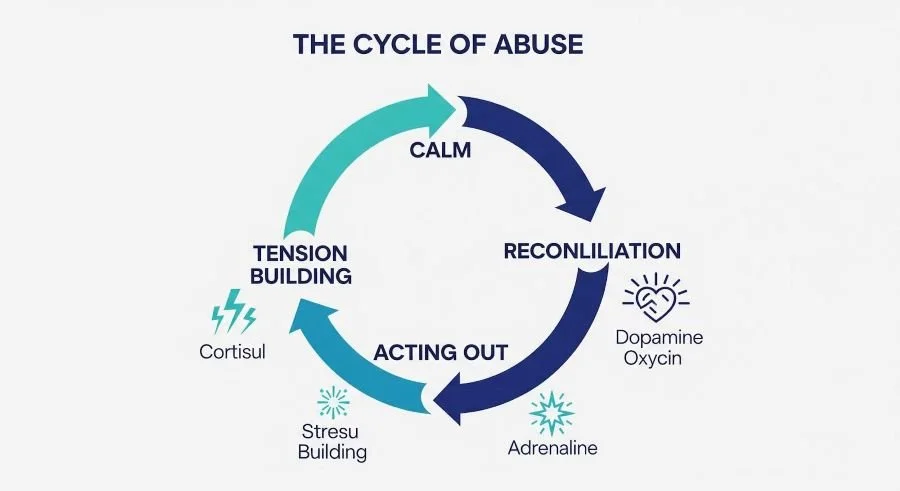
The 4 Phases of the Abuse Cycle: A Clinical Breakdown
To understand how abuse starts, we must look at it as a recurring cycle. Most abusers are calculated, working slowly to disconnect you from your support systems and your own intuition. According to the National Domestic Violence Hotline's framework on Power and Control, this cycle creates a sense of "homeostasis"—a new, albeit toxic, normal that the brain resists changing.
1. Tension Building
Communication breaks down. You start "walking on eggshells" to avoid upsetting your partner. In this stage, anxiety becomes a constant companion, as the body prepares for the inevitable "crash."
2. The Acting Out Phase
This is where the abuse occurs. This is the moment where the "Prefrontal Cortex" (the logical brain) is often completely bypassed by the "Amygdala" (the fear center).
3. Reconciliation (The Trap)
Commonly known as the "Honeymoon" phase, this is when the abuser begs for forgiveness. It is during this phase that victims often experience the psychology of abuse healing in reverse, where the abuser mirrors a healthy partner to maintain the bond.
4. Calm (False Homeostasis)
The abuse stops temporarily. Promises are made but rarely kept. You want to believe the abuser has changed, which allows the brain to minimize the previous trauma in favor of current peace.
🔍 Relationship Reality Check
Does your relationship feel like an emotional rollercoaster? Ask yourself these three questions:
Do I feel like I am constantly "walking on eggshells" to prevent an explosion?
Do I justify my partner's behavior by focusing only on the "good" times?
Do I feel physically or emotionally "stuck" even when I know the relationship is harmful?
If you answered "Yes" to any of these, you may be experiencing a trauma bond. You are not alone, and help is available.Explore our Trauma-Informed Services.


Why "Just Leaving" Isn’t Simple: The Nervous System Perspective
The most common question survivors face is: "If it's so bad, why don't you just leave?" This question fails to account for the Somatic Freeze response.
The Amygdala vs. The Prefrontal Cortex
When you are in a state of chronic stress, your logical brain goes offline. Leaving requires complex planning, but in "survival mode," your brain is only capable of focusing on the next five minutes of safety. This is a state we often call when your brain crashes.
The Somatic Freeze
Many victims experience a "frozen" feeling during conflict. This is a biological defense mechanism known as Dorsal Vagal Shutdown. As explored in Bessel van der Kolk’s seminal work, The Body Keeps the Score, your nervous system decides that the safest thing to do is to be still.
✨ Pattern Interrupt: Healing the Nervous System
The "Somatic Freeze" cannot be "talked" away—it must be processed through the body. Our specialized therapists in San Diego and Fair Oaks utilize EMDR and Somatic Experiencing to reach the parts of the brain where trauma bonds are stored.
View our EMDR & Somatic Services
If you are ready to move from understanding the cycle to taking action, we provide a comprehensive guide on how to leave an abusive relationship safely.
The Chemical Cocktail: Addiction to the Highs
Leaving an abusive partner is chemically similar to drug withdrawal. Research published by the National Institutes of Health (NIH) details how traumatic attachment creates neurobiological pathways that prioritize the abuser as a primary source of regulation.
The brain becomes "addicted" to the relief of the dopamine hit that follows the cortisol spike. This is remarkably similar to the patterns we see in substance use counseling, where the "substance" is the intermittent affection of the partner.
The Myth of "Being Strong Enough"
Society often views staying as an act of weakness. This perspective is fundamentally flawed and actually aids the abuser by shifting the blame onto the victim. The decision to leave is an empowered choice, but it is not a barometer of strength. Many high-achieving, "strong" individuals find themselves trapped because biological hooks do not care about your resume.
Breaking the Addiction: How Therapy Heals the Trauma Bond
If you feel "addicted" to a partner who hurts you, know that you are not weak. At Whole Wellness Therapy, we address the body and the mind:
EMDR Therapy: Helps the brain re-process traumatic memories so they no longer trigger a "freeze" response.
Somatic Experiencing: Regulates the nervous system to help you reclaim your sense of agency.
Individual Counseling: Deconstructs gaslighting and rebuilds self-worth, which is crucial for overcoming depression that often follows prolonged abuse.
Survivors often find the most success by choosing between EMDR and Somatic Experiencing to address how trauma is stored in the body.
How to Start Healing: Your Path to Safety
If you are ready to move from understanding the cycle to breaking it, we recommend these three steps:
Safety Planning: This is the most critical first step. Ensure you have a support system and a safe place to go.
Nervous System Regulation: Work with a trauma-informed therapist to learn how to move out of the "freeze" state.
Seek Specialized Support: Trauma bonds require specialized intervention that addresses the neurobiology of attachment.
A Message from Isaac Smith
"Healing from a trauma bond is one of the most courageous things a person can do. It’s not just about leaving a relationship; it’s about reconnecting with a part of yourself that has been silenced. We are here to walk that path with you."
Learn more about the author and founder of Whole Wellness Therapy Here
Choose Your Path to Recovery
Our expert clinical team provides trauma-informed care both in-person and online across California. Choose the location that works best for you to begin your consultation:
Seeking Care in Fair Oaks? Meet our Fair Oaks Team & Schedule Here
Searching for Care in Sacramento? View our Sacramento Therapy Services
Searching for Care in San Diego? Meet our San Diego Clinical Team
Prefer the Flexibility of Remote Sessions? Explore our Online Therapy Options
Frequently Asked Questions (FAQ)
What are the first signs of an abusive relationship?
The earliest sign is often "Love Bombing," an intense period of excessive attention designed to create dependency. This is a grooming phase.
Why do I still love someone who abused me?
This is the hallmark of a trauma bond. Your brain is experiencing a chemical withdrawal symptom fueled by oxytocin and dopamine.
Can an abuser change if I love them enough?
No. Change is only possible if the abuser takes 100% responsibility. NIH studies show that without intensive intervention, these patterns usually escalate.
Break the Cycle Today
Whether you are currently feeling "frozen" or are struggling with the aftermath of leaving, our approach centers on learning to love ourselves unconditionally as the first step in reclaiming your life.
If you are in immediate danger, please contact the National Domestic Violence Hotline at 800-799-7233.
References & Citations:
Bessel van der Kolk, M.D. (2014). The Body Keeps the Score.
National Domestic Violence Hotline: Understanding the Cycle of Abuse.
National Institutes of Health (NIH):The Neurobiology of Attachment and Trauma.