

Can Abusers Change? What the Research (and Your Nervous System) Want You to Know
Key takeaways:
Government-reviewed research on abuser "reform" is genuinely mixed: some intervention models show a small measurable effect, others show none, and many participants never finish the program.
The more useful question usually isn't "can they change" — it's "are they already changing, right now, without being asked."
Hoping for change often isn't naive. It's your nervous system doing exactly what a trauma bond trains it to do.
Real change looks like sustained accountability over years. Performed change looks like promises after a blow-up.
Either way, your healing doesn't have to wait for their answer.
If you're here, you've probably asked this question more times than you can count. Maybe at 2am. Maybe mid-argument. Maybe right after an apology that sounded, for a second, like it might actually be true this time.
Can they change?
We're not going to give you a stock answer. We're going to give you what the research actually says, what your brain is doing with that question, and what we'd want you to know if you sat across from us in one of our Sacramento or San Diego offices.
So, Can Abusers Change? The Honest Answer
Here it is, plainly: sometimes, but rarely, and almost never quickly.
That's not us being cagey. It's what the government's own research shows. The National Institute of Justice's review of court-mandated intervention programs found genuinely mixed results — one widely used model was rated effective for reducing violent recidivism, while a comparable cognitive-behavioral approach showed no measurable effect at all. A broader clinical research review puts it more bluntly: across two decades of studies, intervention attendance is associated with only a small average reduction in abuse — and a meaningful share of participants never finish the program at all.
So change is possible. It's just uncommon, slow when it happens, heavily dependent on which program (if any) someone actually completes, and almost never driven by an ultimatum.
Why This Question Doesn't Have a Simple Answer
Part of what makes this so disorienting is that experts genuinely disagree on why people become abusive in the first place — and that disagreement shapes whether "change" even sounds achievable.
One camp, led by counselors like Lundy Bancroft — author of the widely referenced Why Does He Do That? — frames abuse as fundamentally a moral problem, not a psychological one. In this view, the abusive person already knows right from wrong; they've simply decided their needs justify overriding someone else's safety. Change, from this lens, requires confronting entitlement — not "healing a wound."
Another camp points to trauma reenactment — people who were harmed early in life unconsciously repeating that harm in adulthood. This doesn't excuse the behavior. It does suggest a different (and longer) treatment path.
In practice, both show up. Some people who abuse are calculated and aware. Others are running old, unprocessed patterns on autopilot. Either way, awareness alone has never been enough. Change requires sustained, uncomfortable work — and most people, understandably, don't choose that path unless something forces the issue.
The Real Question Isn't "Can They" — It's "Are They, Right Now"
Here's the reframe we actually want you to sit with: capability isn't the same as action.
Plenty of people are theoretically capable of change. Very few are doing the actual work — in therapy, consistently, without you managing it for them.
So instead of trying to predict the future ("will he change eventually"), it's more useful to look at the present tense: Is real accountability happening right now, unprompted, and has it lasted longer than a single good week?
That question has an answer you can actually observe. The other one doesn't.
The Neurobiology Behind Why You Keep Hoping
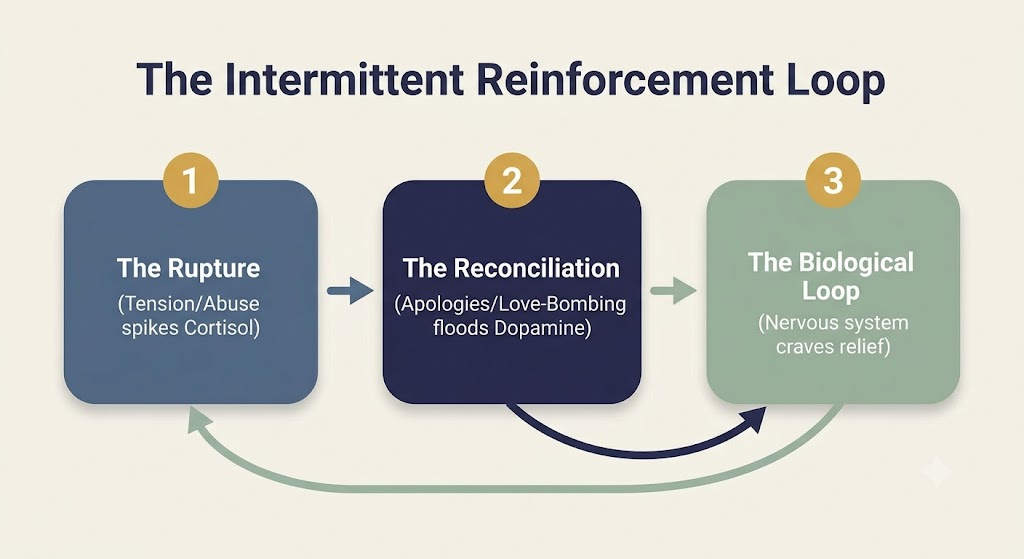
This is the part most articles on this topic skip entirely, and it's the part we think matters most.
Hoping they'll change isn't a character flaw. It's often a trauma bond — a literal, physiological attachment created by the same intermittent reinforcement pattern used, unintentionally or not, in slot machines and, tragically, in abusive relationships.Research on the shared neural pathways between attachment and addiction shows dopamine-driven reward circuits and oxytocin-driven bonding circuits genuinely overlap — which is part of why this doesn't just feel like an addiction. In a real sense, it functions like one.
In our intake sessions, this is often the moment we watch a client exhale for the first time — the moment "why can't I just stop hoping" turns into "oh, that's not a character flaw, that's chemistry."
Here's roughly how it works in the body:
The rupture — a cycle of tension or abuse spikes cortisol, your body's primary stress hormone.
The reconciliation — an apology, a "good phase," or love-bombing follows, flooding the brain with dopamine and relief.
The loop — because the highs and lows are unpredictable, your nervous system starts craving the relief as much as it fears the rupture. That's not weakness. That's neurochemistry doing precisely what it's built to do.
We've written before abouthow abusive relationships start and why people stay — this cycle is the engine underneath it. And when your prefrontal cortex (the part of your brain that plans and reasons long-term) goes offline under chronic stress, it becomes even harder to evaluate the relationship clearly. We break that shutdown down inwhen your brain crashes.
None of this means you're incapable of seeing clearly. It means your body has legitimate biological reasons for hanging onto hope — and understanding that can take some of the shame out of the question.
Real Change vs. Performed Change
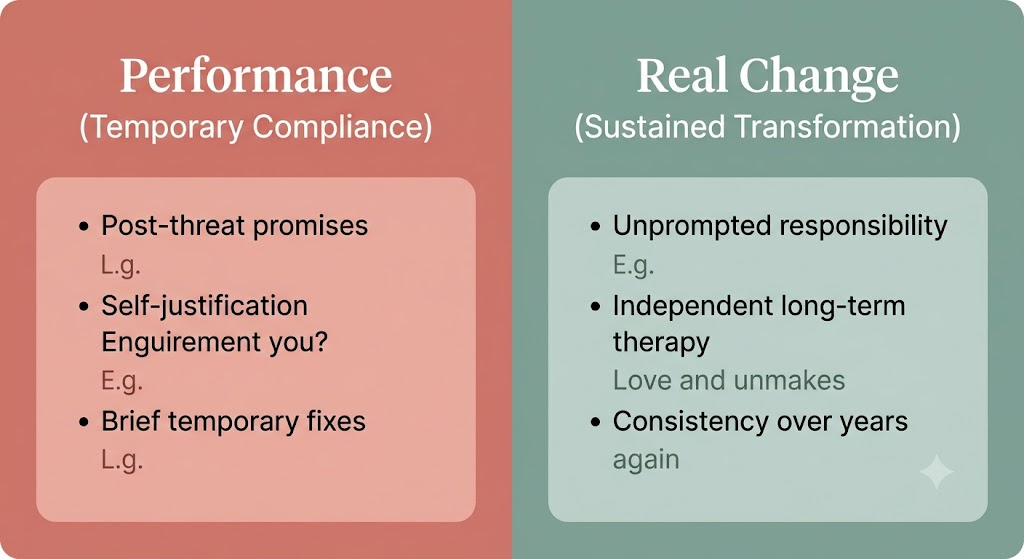
Because "he seems different" can mean two very different things, here's what we watch for clinically.
Signs that tend to be performance, not change:
Promises made only after you've pulled away or threatened to leave
Apologies that pivot quickly into justifying the behavior ("I only did that because...")
Gestures (gifts, grand apologies) with no follow-through in daily behavior
Change that lasts days or weeks, then quietly resets
Signs that tend to reflect real, sustained change:
Taking full responsibility, without minimizing or redirecting blame onto you
Actively seeking help — individual therapy, a certified intervention program — without being forced into it repeatedly
Respecting boundaries the first time, not just after conflict
Consistency measured in years, not weeks
If you're only seeing the first list, that's information — not a verdict on your judgment.
What This Means for You, Right Now
We want to be careful here, because this question so often gets asked from a place of exhaustion, not idle curiosity.
Whether or not someone else changes is ultimately outside your control. What is inside your control is how supported and regulated you feel while you figure out your next step — whether that's staying, leaving, or simply getting clear-headed enough to decide.
That's the work we do at Whole Wellness Therapy: helping you get your nervous system out of survival mode long enough to think, plan, and heal — regardless of what anyone else decides to do. If you're weighing next steps, our guide onthree things to do before you leave an abusive relationship is a practical place to start, andhealing after abuse: rebuilding walks through what comes after.
Many of our clinicians integrateEMDR andBrainspotting specifically because talk alone often can't reach where this kind of stress lives in the body — we go into that more insomatic therapy and EMDR: why your body holds the key to abuse recovery.
Quick Answers
Do abusers know what they're doing? Often, yes — many are aware in the moment, even if they later minimize it to themselves. Others are running older, unconscious patterns. Either way, awareness isn't required for accountability, and lack of awareness isn't an excuse.
Can an abuser change without professional help? It's uncommon. Sustained change almost always involves structured accountability — individual therapy, and often a certified intervention program — sustained over years, not a private resolution made after a fight.
Do abusers love their victims? Many people who abuse experience real attachment alongside abusive behavior — the two aren't mutually exclusive. That coexistence is part of what makes trauma bonds so disorienting, and it doesn't change what safety requires.
How long does real change typically take? Clinicians who specialize in this work generally estimate a minimum of one to two years of consistent, demonstrated behavior change — not months.
If you are in immediate danger, please call 911. For confidential support, theNational Domestic Violence Hotline is available 24/7 at 1-800-799-7233 or by texting "START" to 88788.
This article is educational and is not a substitute for individualized therapy, medical advice, or a personal safety assessment. It does not evaluate the safety of any specific relationship, and it isn't a tool for predicting another person's future behavior. If you're navigating a relationship where you're unsure what's safe,our trauma-informed therapists across Sacramento, Fair Oaks, and San Diego are here to help you think it through — no judgment, no pressure, just space to figure out your next right step.
This article was written by the team at Whole Wellness Therapy and clinically reviewed by Isaac Smith, MAT, LCSW, FNTP, Founder and Clinical Director of Whole Wellness Therapy. Isaac's clinical work centers on the neurobiology of trauma, addiction, and relational harm, and he has spoken publicly on domestic abuse recovery, including on the podcast Something Was Wrong*. Learn more on hisauthor page.*